Executive Summary
Carbonic acid (H₂CO₃), formed when carbon dioxide (CO₂) dissolves in water, is a naturally occurring and environmentally safe water treatment solution for agriculture. This paper explores its role in irrigation systems, its effects on soil chemistry and biology, and the downstream impacts on nutrient availability, plant health, and yield.
- Introduction to Carbonic Acid in Agriculture
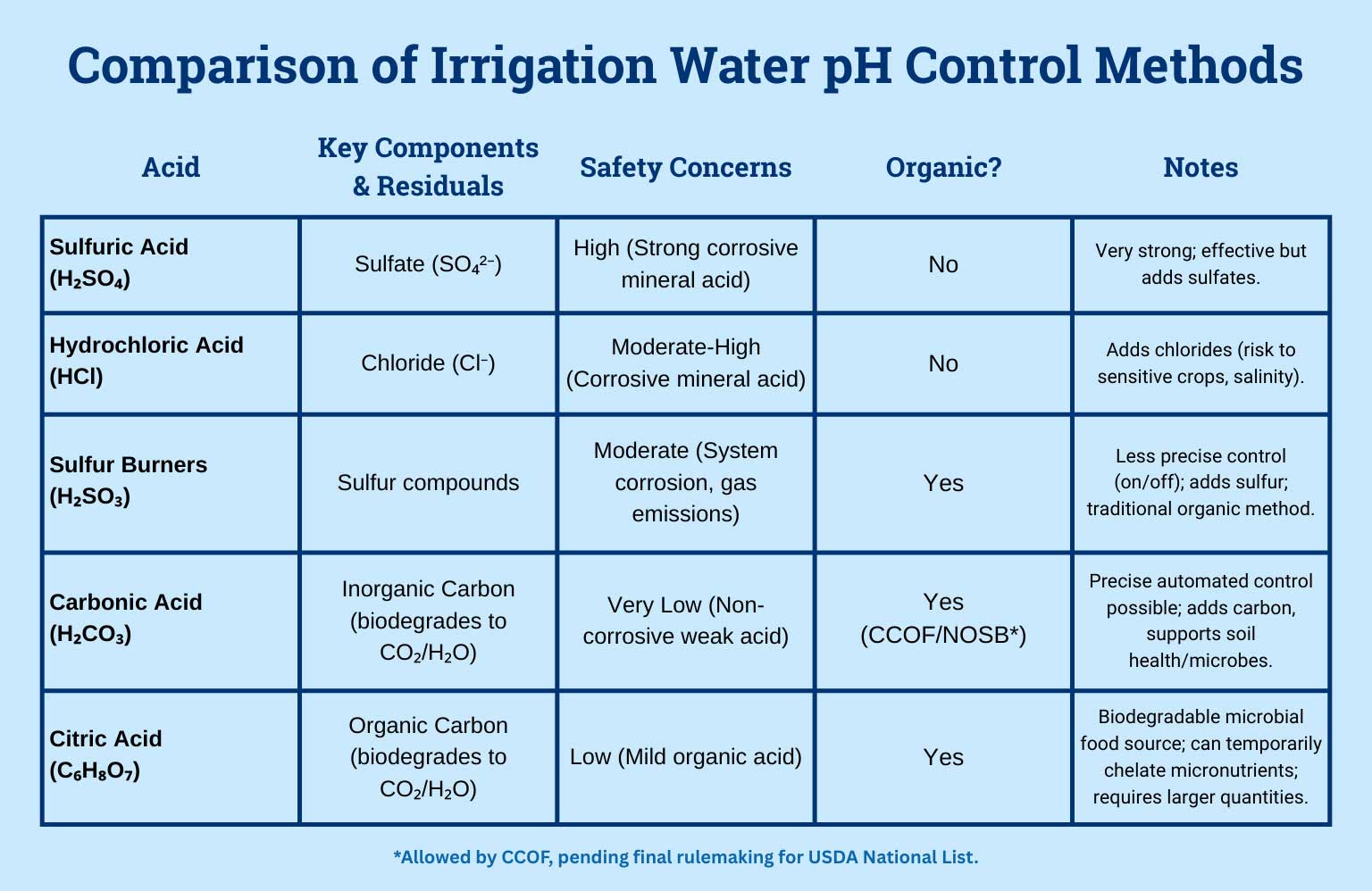
Carbonic acid is a weak, transient acid formed by the dissolution of CO₂ in water. In modern agriculture, it is increasingly used in irrigation systems to manage pH levels and mitigate the negative effects of alkaline water. It provides a natural alternative to hazardous mineral acids like sulfuric or phosphoric acid and can be generated safely on-site using CO₂ gas injection systems. As growers seek safer, more sustainable water treatment methods, carbonic acid stands out for its efficacy, safety, and agronomic benefits. - Agronomic Functions of Carbonic Acid
2.1 pH Regulation
Carbonic acid gently lowers irrigation water pH into the optimal range of 6.0 to 6.5, which enhances the solubility of many essential plant nutrients. Unlike stronger acids, it does not drastically alter pH and instead buffers the water gently, maintaining a consistent environment for both plants and beneficial soil microbes. This helps avoid nutrient lockout, a common problem when water pH is too high, which can render key nutrients insoluble and unavailable to crops (Ayers & Westcot, 1985).
2.2 Enhanced Solubility of Nutrients
When water pH is maintained in the slightly acidic range using carbonic acid, several nutrients—including phosphorus (P), iron (Fe), manganese (Mn), and zinc (Zn)—become more available to plants. At high pH levels, these nutrients tend to precipitate out of solution or become chemically bound to soil particles. Carbonic acid treatment improves nutrient uptake efficiency by keeping them in a soluble and plant-accessible form (Oster & Suarez, 2001). - Soil Chemistry and Microbial Impacts
3.1 Improved Calcium and Magnesium Management
In calcareous or alkaline soils, calcium carbonate (CaCO₃) can bind calcium and reduce its availability. Carbonic acid reacts with calcium carbonate in the following reaction:
CaCO₃ + H₂CO₃ → Ca²⁺ + 2HCO₃⁻
This releases calcium into the soil solution and contributes to improved soil structure through flocculation. The result is better root penetration and enhanced soil tilth (Fenn et al., 1986).
3.2 Bicarbonate Reduction
High bicarbonate concentrations in irrigation water can displace calcium and magnesium from the soil exchange complex, leading to sodium accumulation and soil dispersion. Carbonic acid neutralizes bicarbonates, thereby preventing these negative effects. This process supports a more balanced soil cation exchange and maintains soil permeability (Suarez, 2000).
3.3 Stimulation of Beneficial Microbial Populations
The slightly acidic environment created by carbonic acid fosters microbial activity by enhancing conditions for organic matter decomposition and nutrient cycling. Beneficial microbes, including nitrogen-fixing bacteria and mycorrhizal fungi, are more active in such environments, which in turn improves nutrient availability and plant health (Sylvia et al., 2005). - Effects on Soil Physical Properties
By reducing sodium hazards and improving calcium availability, carbonic acid promotes the formation of stable soil aggregates. This leads to improved water infiltration, reduced runoff, and better root zone aeration. Flocculated soil also holds water more effectively, supporting plant health during dry periods. In contrast, untreated alkaline water can cause surface sealing and crusting, which limit seedling emergence and water penetration (Ayers & Westcot, 1985). - Crop Productivity and Health Benefits
5.1 Nutrient Uptake Efficiency
Improved water and soil pH conditions created by carbonic acid treatment enable better uptake of both macronutrients (e.g., nitrogen, potassium) and micronutrients (e.g., iron, zinc). This
reduces the need for corrective foliar sprays and improves overall plant metabolism (Oster & Suarez, 2001).
5.2 Increased Yield and Quality
Field trials and grower case studies report increased yields, better fruit uniformity, and improved crop quality when carbonic acid is used for irrigation water treatment. Enhanced nutrient availability contributes to better flowering, fruit set, and development. Balanced mineral nutrition also leads to improved crop storability and marketability (UCANR, 2021).
5.3 Reduced Fertilizer Inputs
With improved nutrient solubility and uptake, growers can often reduce their total fertilizer inputs. This lowers production costs and minimizes the risk of nutrient leaching and runoff, supporting both economic and environmental sustainability (Ayers & Westcot, 1985). -
Advantages over Traditional Acids
Carbonic Acid- Safety: Non-corrosive, safe to handle
- Soil Biology: Stimulates microbial activity
- Equipment Wear: Non-corrosive to pipes and pumps
- Environmental Risk: Biodegradable, low runoff risk
- Nutrient Availability: Improves micronutrient solubility
- Safety: Highly corrosive, hazardous
- Soil Biology: Can sterilize soil
- Equipment Wear: Corrosive
- Environmental Risk: High runoff and safety risk
- Nutrient Availability: Can lock some nutrients
- Safety: Corrosive
- Soil Biology: Can suppress microbes
- Equipment Wear: Corrosive
- Environmental Risk: Medium risk
- Nutrient Availability: Adds phosphorus, may affect balance
- Implementation Considerations
7.1 System Design
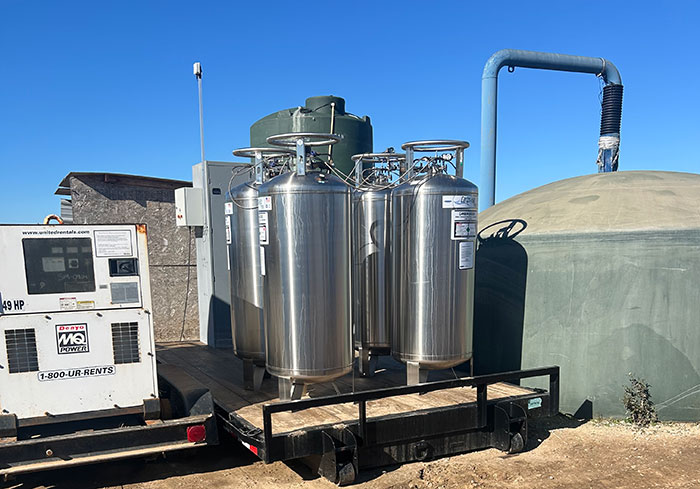
Carbonic acid is typically generated on-site using CO₂ injection systems that dissolve gas into water via inline venturi or diffusers. These systems are compatible with all types of irrigation, including drip, micro-sprinkler, and surface irrigation.
7.2 Dosage and Monitoring
Water treatment targets typically aim for a pH of 6.2 to 6.5. The required CO₂ dosage depends on the alkalinity and flow rate of the irrigation water. Inline pH and EC sensors can be used to automate dosing and ensure consistency.
7.3 Economic Value
Carbonic acid provides long-term savings by reducing the need for fertilizer and acid purchases, extending irrigation system life, and improving crop performance. It also eliminates the safety and liability concerns associated with strong acids. - Case Studies and Research Highlights
Growers in California’s Central Coast who transitioned to carbonic acid for pH control have reported yield increases of 15–30%, better fruit quality, and reduced emitter clogging. Laboratory analyses of treated fields show higher levels of available calcium and zinc, and reduced bicarbonate levels.
University trials (UCANR, 2021) also confirm carbonic acid's effectiveness at reducing bicarbonate toxicity and improving nutrient solubility without harming soil biology. - Conclusion
Carbonic acid offers a powerful, natural solution for optimizing irrigation water and soil health. By addressing high pH and bicarbonate issues without introducing harmful residues, it improves nutrient availability, supports microbial life, and enhances crop performance. For growers seeking safe, sustainable, and effective water treatment, carbonic acid represents a significant agronomic advancement. - References
• Ayers, R. S., & Westcot, D. W. (1985). Water Quality for Agriculture. FAO Irrigation and Drainage Paper 29 Rev. 1.
• Oster, J. D., & Suarez, D. L. (2001). "Management of Irrigation Water Quality for Sustained Crop Production."
• Fenn, L. B., Miyamoto, S., & Swietlik, D. (1986). "Dissolution of calcium carbonate in irrigation water." Soil Science Society of America Journal.
• Sylvia, D. M., Fuhrmann, J. J., Hartel, P. G., & Zuberer, D. A. (2005). Principles and Applications of Soil Microbiology. Pearson.
• Suarez, D. L. (2000). "Impact of bicarbonate on soil properties and irrigation management." USDA ARS.
• UCANR (2021). California Cooperative Extension Trials and Recommendations on Water Treatment and Soil Amendments.